

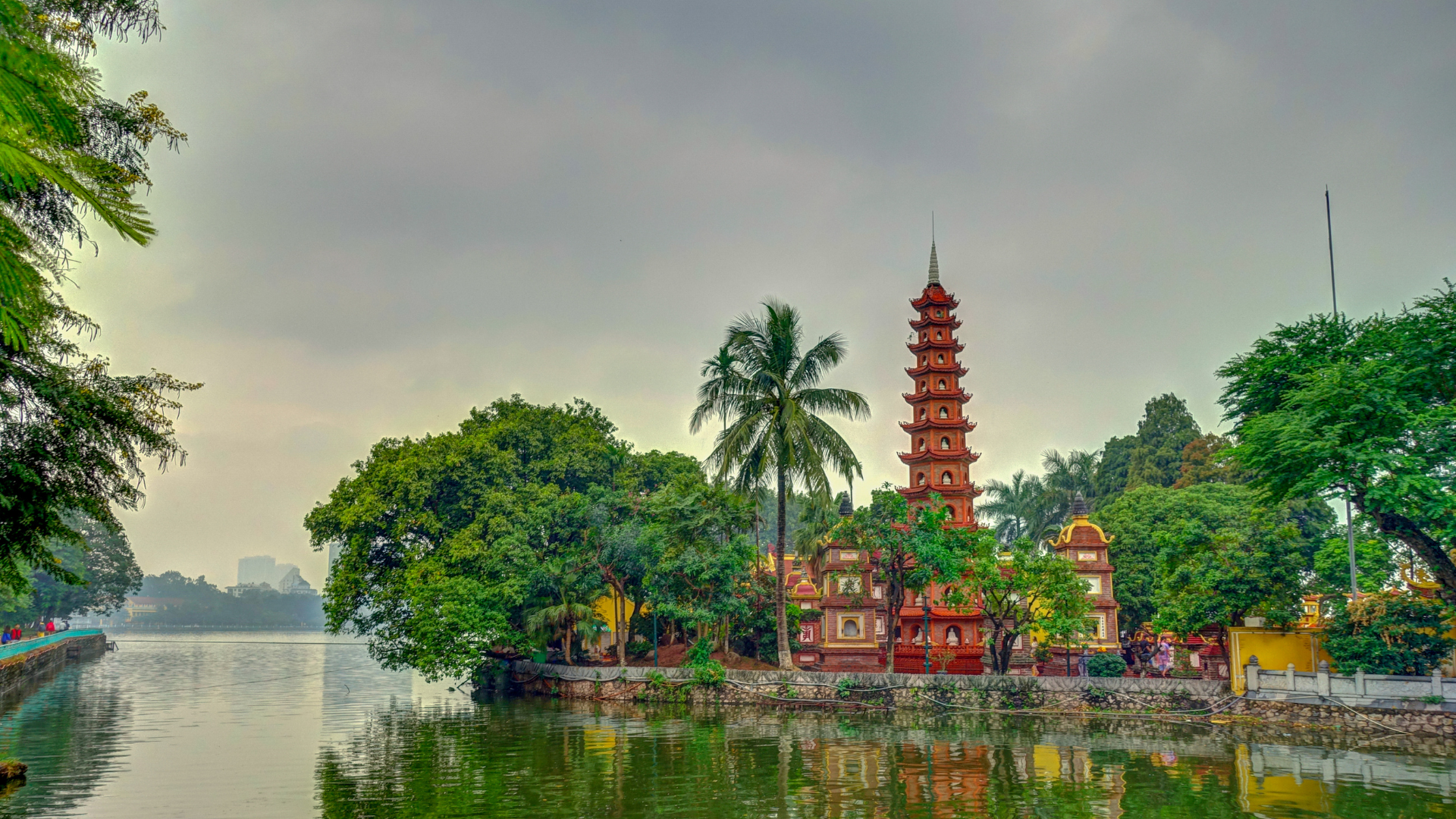
Hanoi "crowned" the second worst air quality city in Southeast Asia
A recent survey by IQAir, a Swiss manufacturer of air purifiers, ranked Hanoi as having the second-least satisfactory air quality in Southeast Asia after Pasarkemis in Indonesia's capital city.
The air quality in Hanoi, the capital city of Vietnam, deteriorated to approximately 40.1 micrograms of PM2.5 particles per cubic meter in 2022 compared with 36.2 μg/m3 recorded in 2021; placing it among the 18 most polluted capitals worldwide according to 116 cities-level data.
The nation's largest metropolis, Ho Chi Minh City experienced a considerable increase of 9.3% in PM2.5 concentrations from the previous year - reaching 21.2 μg/m3.
Vietnam's annual average PM2.5 concentration of 27.2 μg/m3 placed it in the third most polluted region within Southeast Asia, after Indonesia (30.4) and Laos (27.6), while ranking 30th worldwide; an alarming statistic. This trend indicates that air pollution is becoming an increasingly prevalent problem for residents across Vietnam, and highlights how urgent it is to take swift remedial actions to improve air quality levels.
The report found that, in Vietnam, power generation; vehicle emissions; industrial factories and open burning are significant contributors to air pollution. During the dry season between November through April PM2.5 concentrations were often higher than expected.
The Vietnamese government has been making concerted efforts to address sources of pollution.
The Ministry of Natural Resources and Environment is collaborating with the United States Agency for International Development (USAID) by funding a five-year project, aptly titled 'Reducing Pollution', which will invest $11.3 million remuneration over this period in an effort to curtail environmental pollutants.
The IQAir study, which encompasses 296 of Southeast Asia's cities, revealed that only eight met the WHO guideline limit for PM2.5 with three from Vietnam - namely Nam Sach , Kinh Mon and Cam Pha.
Vietnam boasts seven cities in the list of 15 least-polluted locations in Southeast Asia, with Nam Sach, situated within northern Hai Duong province as the region's cleanest. Indonesia has six. Asia's coastal metropolises were well-represented on the list of 15 most polluted cities, with seven and five cities in Thailand and Indonesia ranking among them respectively.
In other Southeast Asia's capital cities, Jakarta had the dubious distinction of being one of the most polluted capitals with a PM 2.5 level of 36.2 μg/m3 and Vientiane was second at 27.6 μg/m3, while Bangkok came in third at 18 μg/m3, followed by Kuala Lumpur which registered 17.6 ug/m3 and Metro Manila that sat close behind with an average reading of 14 ug per meter cube.
IQAir's study measures harmful airborne particulates PM 2.5 at 7,323 cities across 131 countries, regions and territories - and it relied on data collected from over 30,000 regulatory air quality monitoring stations as well as low-cost sensors.
Lahore, Pakistan's bustling capital city, ranks as the most polluted city on earth with an average PM2.5 level of 97.4 μg/m3 - making it significantly more polluted than Roanoke Rapids in North Carolina U.S., which boasts an astounding 0.6 concentration! Canberra in Australia is no slouch either – it holds the distinction of being the world's cleanest capital (with an average PM2.5 level of 2.8).
Based on this survey, Chad is the most polluted nation on earth, and Guam's the cleanest.
Source: VNExpress