


Sandstorm wreak havoc across China's cities with noxious haze and hazardous air pollution.
On Wednesday, March 22, 2023, Northern China was subjected to widespread sandstorms that impaired visibility and severely disrupted the supply of breathable air for millions of its inhabitants.
Air quality in multiple northeastern provinces of China has reached hazardous levels, as indicated by many air quality monitors.
China's frequent dust storms typically occur during the spring and early summer. Gobi Desert winds carried sand and dust into central and eastern China from its northern reaches, leading to elevated levels of air pollution in several northeastern provinces. Air quality monitors across the region recorded dangerously high readings.
Beijing, China's air quality index reached a staggering 1,575 at 6 AM on Tuesday morning while hazardous levels of pollution range from 300 up!

Hazardous air quality across northern China was measured by air quality monitors on March 22, 2023. Source: IQAir.

The wide band of hazardous air quality affected millions in some of China’s most densely populated cities. Source: IQAir.
Hazardous sand and dust coat cities
Air quality monitors have detected hazardous air quality and elevated concentrations of particulate matter pollutants across numerous Chinese cities.
Winds carried the desert sands and scud southeast of the Gobi Desert, depositing them in densely populated areas. Weather experts foresaw that as the storm continued its journey southward – albeit at a slower pace – it would eventually slow down.
By 8 AM PST, China's most polluted locations were concentrated in its northeastern provinces. Jining, Taian, Liaocheng and Yanzhou – which are situated southeast of Beijing – ranked within the nations top ten most polluted cities. In addition to this were Hegang, Shuangyashan, Jiamusi, and Mudanjiang all located in Heilongjiang Province adjacent to Russia, and including Kaifeng and Jiaozuo, both bordering Shandong Province.
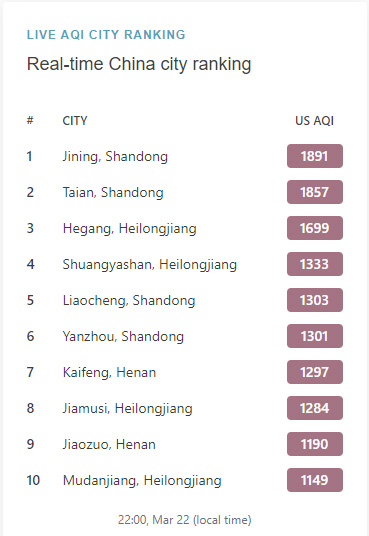
The ten most polluted cities in China at 8 AM on March 22 all had AQIs in the hazardous range from 1,149 to 1,891. Source: IQAir.
Throughout China's most stricken regions, the presence of hazardous air quality ranges from 1,149 to as high as 1,891.
Air monitors in China have detected elevated concentrations of PM2.5 and PM10 particles. Microns are used to determine particulate matter sizes, with 2.5 micron for PM2.5 and 10 micron as examples for PM10. PM10 particles are larger and, thus, less hazardous than those found in PM2.5 which can penetrate deep into critical systems within the body. The larger particles also don’t linger in the air as long as PM2.5 does, however both particulates pose a risk to human health as well as contributing towards cardiovascular ailments such as coronary disease/stroke; respiratory illnesses like asthma; cancer-related conditions such as lung cancer or COPD; among others.
While concentrations of particulate matter (PM2.5) rise in China, PM10 measurements were substantially higher. This disparity is not surprising during sandstorms as dust and sand particles are often found within PM10 particle size.
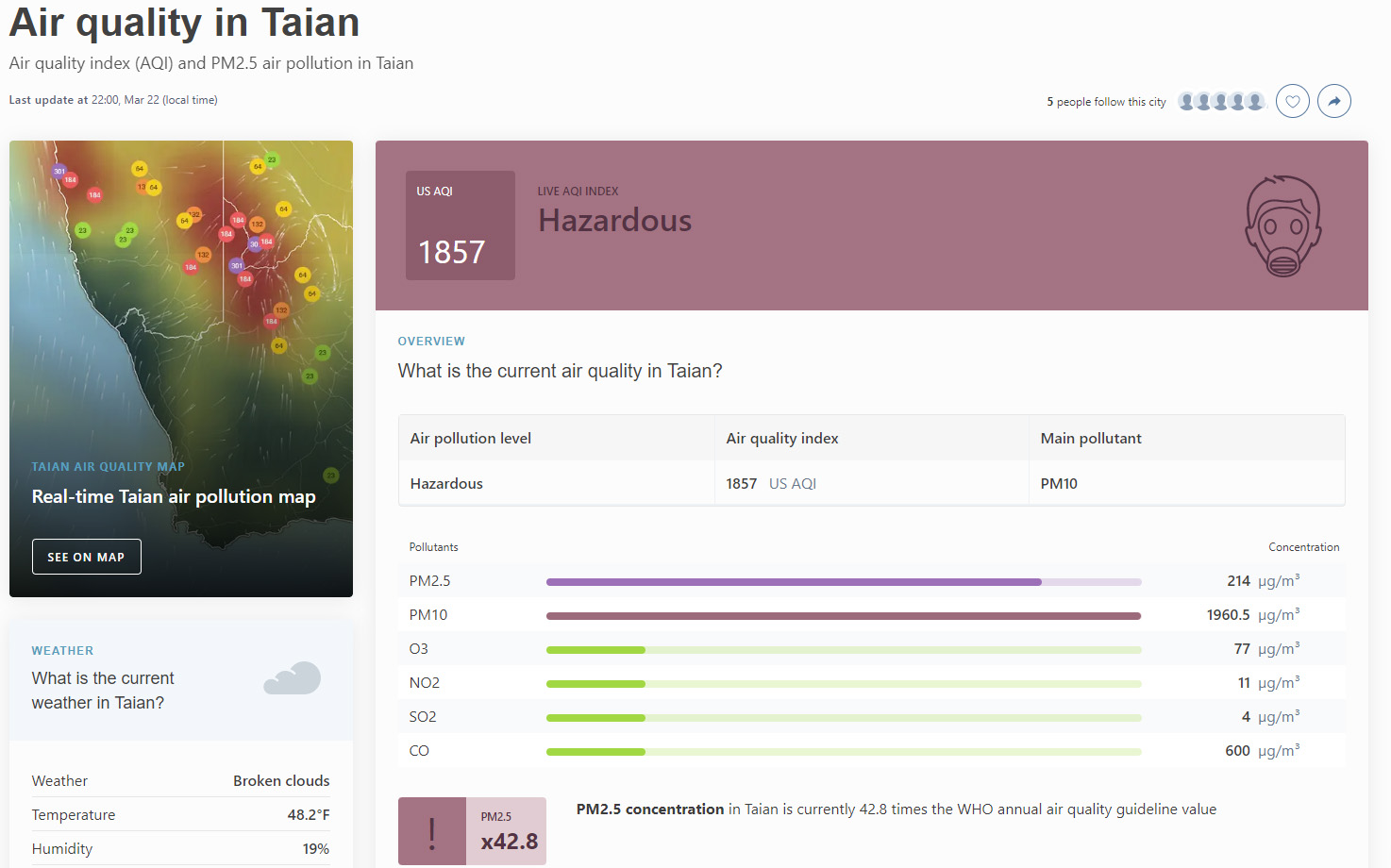
Hazardous air quality levels were measured in Taian. Source: IQAir.
In Taian, the hourly average PM2.5 concentration was 214 µg/m3 at 11 AM, while that of PM10 reached 1,961 µg/m3.
In China, intense dust storms experienced rapid movement in some locales, subsequently resulting in heightened concentrations of pollutants and then subsiding with time. For instance, at 6 AM in Beijing the average concentration of PM2.5 was 401 µg/m3, while PM10 reached 1-677 µg/m3: an indication that a severe storm is taking place.
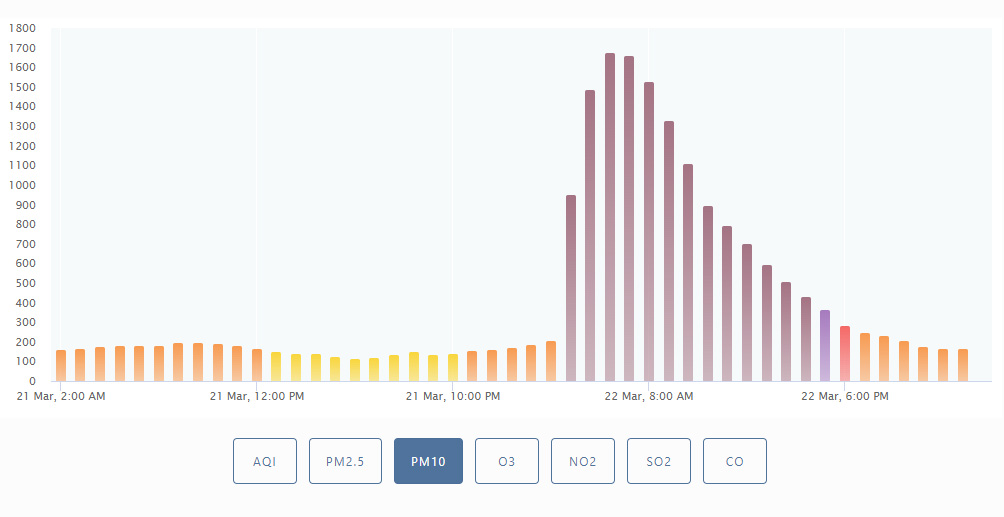
Hourly average concentrations of PM10 in Beijing spiked with the sandstorm’s initial onslaught but subsided later in the day. Source: IQAir.
At 1 AM, hourly average concentrations of PM10 had lowered to 169 µg/m3 - still an unacceptably high level - but not nearly as jarring as the extraordinary peaks witnessed earlier in the day.
Conclusion
The recent sandstorm in China serves as an important reminder that air quality awareness is a vital component of public health. We cannot act unless we know what's in the air around us, giving us the power to protect ourselves.
When sandstorms descend upon an area, there are several precautions one can take to safeguard themselves:
- Quality KN95/FFP2 mask is critical to preventing inhospitable elements such as sand and dust from entering one's respiratory space.
- To avoid bad air day, stay indoors and steer clear of busy areas.
- If necessary, avoid driving or pull over in gusty winds and poor visibility.
- Close the doors and windows, along with any vents.
- Run an air purifier.
About IQAir
IQAir is a renowned Swiss technology company, committed to empowering individuals, organizations and governments with knowledge-based solutions for certain improvements in air quality.