

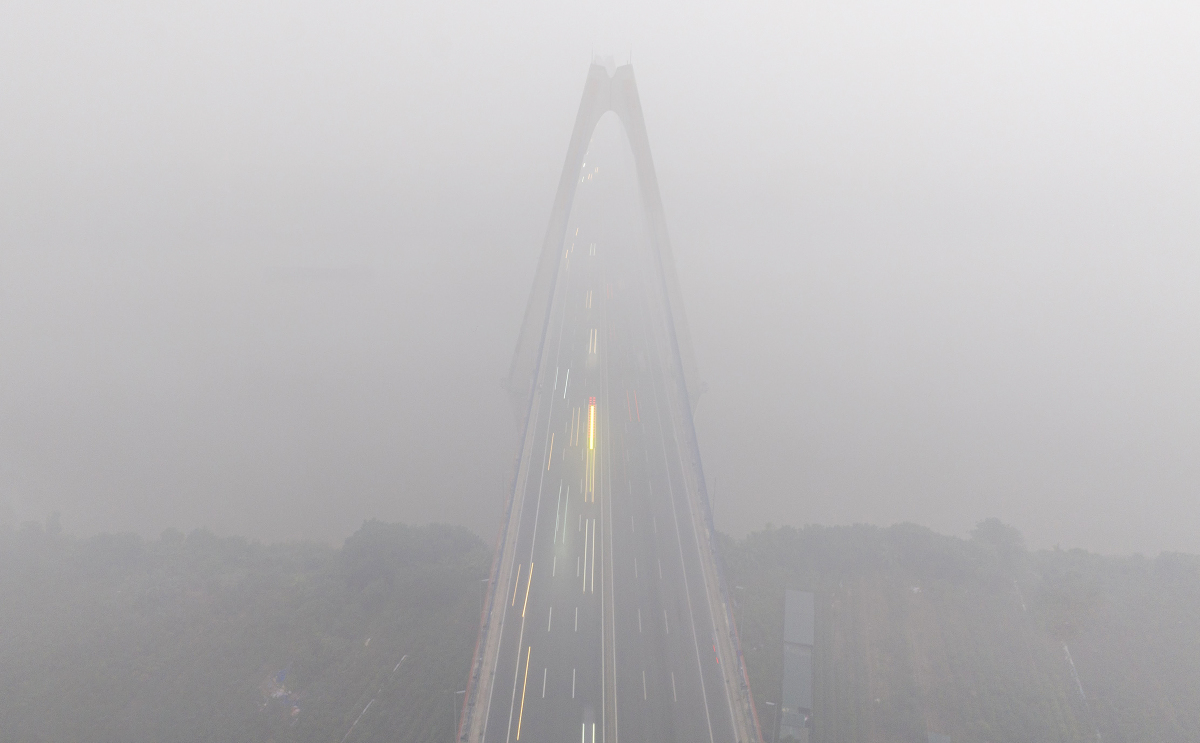
Hanoi Enveloped in Smog as Air Quality Takes a Nosedive
Throughout the past month, Hanoi has grappled with consistently poor air quality, particularly during morning and evening hours, attributed to elevated emission levels.
At 6 a.m. on Monday, sections of the Nhat Tan Bridge connecting Tay Ho and Dong Anh districts were barely visible amidst the smog, requiring vehicles to illuminate their headlights for visibility. The Long Bien Bridge, linking Hoan Kiem and Long Bien districts, also faced partial obscurity due to the thick haze.
Environmental experts have pointed to the recurrence of smog from October to March, citing factors such as insufficient rainfall, dense fogs, and inadequately managed emissions, preventing the dispersion of pollutants and leading to heightened concentrations at lower levels.
Skyscrapers in Nam Tu Liem District vanished from view, including the peak of the 350m-high Keangnam Tower, entirely obscured by the smog. Aerial views of Ring Road 3 were shrouded in clouds and smog, with multiple air quality stations indicating either very poor or hazardous Air Quality Index (AQI) levels.
For instance, a Pollution Control Department-managed station on Nguyen Van Cu Street in Long Bien District recorded a November 28 AQI level of 225, classified as very poor air quality. Among the Hanoi Department of Natural Resources and Environment's 16 air quality stations, the one on Pham Van Dong Street in Bac Tu Liem District registered the highest AQI levels at 194, nearing "very poor" air quality.
Nguyen Trai Street, West Lake, and the Xa La urban area in Ha Dong District were all blanketed in smog, prompting residents to wear face masks during outdoor activities.
By 7:55 a.m., an AQI level of 134 was recorded at a station in Thanh Xuan District, with Tay Ho and Long Bien districts experiencing the most pollution, reaching AQI levels of 158, leading authorities to advise residents against outdoor activities.
On Sunday night, heightened AQI levels prompted drivers on Nguyen Trai Street in Ha Dong District to use headlights for visibility through the smog. Consequently, Hanoi has been ranked as the fourth most polluted city globally by the Switzerland-based air quality monitoring facility IQAir AirVisual.
Environmental agencies attribute Hanoi's pollution to traffic emissions, exacerbated by the city's 7.8 million vehicles, including over 1 million cars, 6.6 million motorbikes, and 184,000 electric motorbikes. Emissions from industrial activities, trash incineration, and construction site dust also contribute to air pollution, particularly during winter when rain is less frequent.
In the provided image, smokes billow from the Van Dien Fused Magnesium Phosphate Fertilizer company in Thanh Tri District, emphasizing the multi-faceted sources of pollution impacting the Vietnamese capital.
Source: VNExpress - Smog covers Hanoi as air quality plummets