


Your Brain Is Dying a Little More Every Day Because of Air Pollution!
The air you breathe each day doesn’t just affect your lungs or cardiovascular system — it’s silently shaping your memory, emotions, and the very development of your central nervous system.
Over the past decade, large-scale epidemiological studies have consistently revealed strong associations between prolonged exposure to airborne pollutants — such as fine particulate matter (PM2.5), nitrogen dioxide (NO₂), and ground-level ozone — and an increased risk of developing neurological disorders including dementia, depression, anxiety, psychosis, and neurodevelopmental conditions in children such as autism spectrum disorder (ASD).
In its 2020 report, The Lancet Commission on Dementia officially recognized air pollution as a significant environmental risk factor for dementia. Similarly, the World Health Organization (WHO) has warned that 99% of the world’s population is breathing polluted air at levels exceeding recommended safety thresholds — placing the neurological health of billions at risk, often without their knowledge.
“Even low-level exposure that people think is safe enough for public health is doing something at the brain level,” says Megan Herting, a neuroscientist at the University of Southern California in Los Angeles.
🧠 How Does Air Pollution Affect the Brain?
🔬 Histopathological and Neuroimaging Evidence
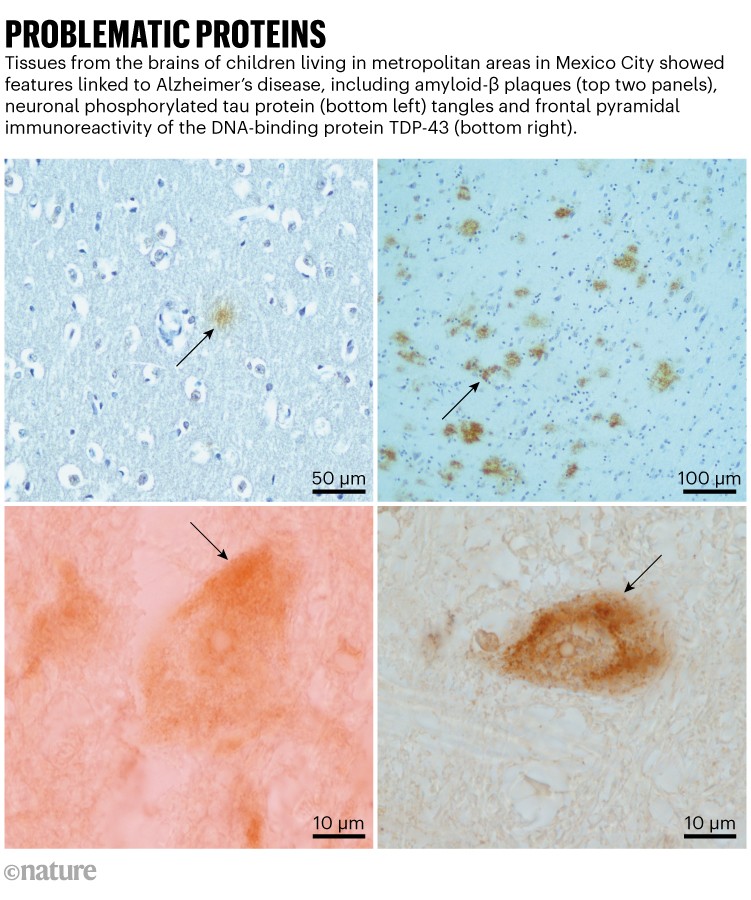
Source: Nature
Studies using magnetic resonance imaging (MRI) and other advanced neuroimaging techniques show:
- Children living in highly polluted urban areas exhibit abnormalities in white matter tracts — the brain’s communication highways — with the prefrontal cortex (which governs executive functions like attention, emotional regulation, and behavior control) being particularly vulnerable.
- In adults, long-term exposure to air pollutants is associated with reduced hippocampal volume, the brain’s memory center, increasing the risk of cognitive decline, memory loss, and disorientation.
🧪 Neurotoxic Infiltration and Accumulation
Particles less than 100 nanometres across are the most chemically reactive airborne particles and the most likely to penetrate the body and brain. They can:
- Move from the lungs into the blood then traverse the blood–brain barrier into the brain,
- Reach the brain directly by travelling from the nasal cavities along the olfactory nerves, and potentially through other nerves
According to Prof. Deborah Cory-Slechta, expert in Environmental Medicine and Neuroscience at the University of Rochester, suspects that the brain can’t cope with the resulting metal concentrations, noting that, for decades, pathologists have seen elevated levels of various metals in the brains of people with neurodegenerative diseases.
🔥 Neuroinflammation: The Silent Spark Behind Cognitive Decline
One of the most consistent findings across studies is that air pollution triggers widespread neuroinflammation.
Chronic neuroinflammation affects all major brain cell types, including:
- Neurons
- Microglia (the brain’s immune defense cells)
- Astrocytes
- And cerebral microvasculature
These inflammatory cascades result in:
- Increased risk of mood disorders (e.g., depression, anxiety)
- Cognitive dysfunction
- Accelerated neurodegeneration, contributing to or exacerbating diseases such as Alzheimer’s and Parkinson’s.
🧪 What Does the Science Say?
- Rodent studies: Prof. Cory-Slechta’s lab found that mice exposed to ultrafine particles during early development — even in utero — showed enlarged brain ventricles, abnormal white matter growth, impaired short-term memory, and increased impulsivity. These anatomical and behavioral changes overlap with characteristics seen in autism and schizophrenia.
- Air pollution also accelerates the accumulation of amyloid-β and tau proteins — hallmarks of Alzheimer’s disease.
- A 2023 analysis of 389,000 individuals in the UK Biobank linked long-term exposure to NO₂ and PM2.5 to higher risks of depression and anxiety, even at low levels.
- Studies in France, the U.S., and China show that improved air quality is associated with lower incidence of dementia and cognitive decline — reinforcing the potential reversibility of some effects through environmental interventions.
🌍 How Can You Protect Your Brain from Invisible Harm?

At IQAir, we believe the first step to protection is knowledge. Here’s how you can reduce your exposure and defend your brain health:
✅ Install high-performance air purifiers (e.g., HyperHEPA) in living spaces — especially in homes with children or elderly individuals.
✅ Monitor real-time air quality levels using AQI apps or sensors, and limit outdoor activity when pollution spikes.
✅ Support your body’s defense mechanisms through a diet rich in anti-inflammatory and antioxidant nutrients such as polyphenols, vitamin E, and omega-3 fatty acids from fruits, nuts, and oily fish.
💡 Clean Air: The Foundation of Cognitive Clarity and Emotional Stability
A sharp mind, balanced emotions, and strong cognitive function don’t begin with supplements or routines. They begin with the air you breathe.
In a world where air pollution has become an invisible yet powerful threat to brain health, taking control of your indoor environment is one of the most effective ways to protect yourself and your loved ones.
🧠 Start today — for a healthier, smarter tomorrow.
IQAir — Empowering intelligent, healthy living through clean air.
Source: Nature (journal)